COVID Surge Disrupts School Year's End as Americans Press Ahead With Summer Plans
U.S. case counts have reached their highest level since mid-February, yet many people are resuming pre-pandemic routines and travel as officials hold back on new restrictions.
By Ishani Kapalli ·
A new wave of COVID-19 is beginning to disrupt daily life as the school year ends, even as many Americans return to pre-pandemic habits and make summer travel plans. Examples of the fallout include a Hawaii high school prom where masked dancers were barred from touching, a Colorado town that went back to virtual city council meetings after the mayor and others tested positive following an in-person session, and a reinstated mask requirement at skilled nursing facilities in Los Angeles County after 22 new outbreaks in a single week.
Johns Hopkins University data show the seven-day rolling average of daily new U.S. cases rose sharply over the past two weeks, from about 76,000 on May 9 to nearly 109,000 on Monday. That is the highest level since mid-February, when the surge driven by the omicron variant was fading. The real figure is probably far higher, because home test results often go unreported and some infections cause no symptoms. Earlier this month, a modeling group at the University of Washington in Seattle estimated that only 13% of cases were being reported to U.S. health authorities.
Hospitalizations are also rising, and more than one-third of the U.S. population lives in areas the Centers for Disease Control and Prevention considers high risk. The Northeast has been hit hardest. Vaccinations have stagnated, and elected officials around the country appear reluctant to impose new restrictions on a public eager to move on, even though the national death toll has passed 1 million less than 2 1/2 years into the outbreak.
Crystal Watson, public health lead at the Johns Hopkins Center for Health Security's Coronavirus Resource Center, said people are likely underestimating how widespread the virus is. "I think there's a lot more virus out there than we recognize," she said, adding that people are "much, much more likely than they anticipate to be exposed and infected."
Deaths continue to decline, and intensive care units are not overwhelmed as they were at earlier points in the pandemic, probably because vaccination and prior infection are keeping many cases milder. Dr. Jonathan Dworkin, a clinical infectious diseases physician in Hawaii, said the disease has changed. Where he once saw a steady stream of severe pneumonia cases, he said, people can now largely avoid that outcome through vaccines, pre-exposure prophylaxis for those at high risk, and early antiviral treatment.
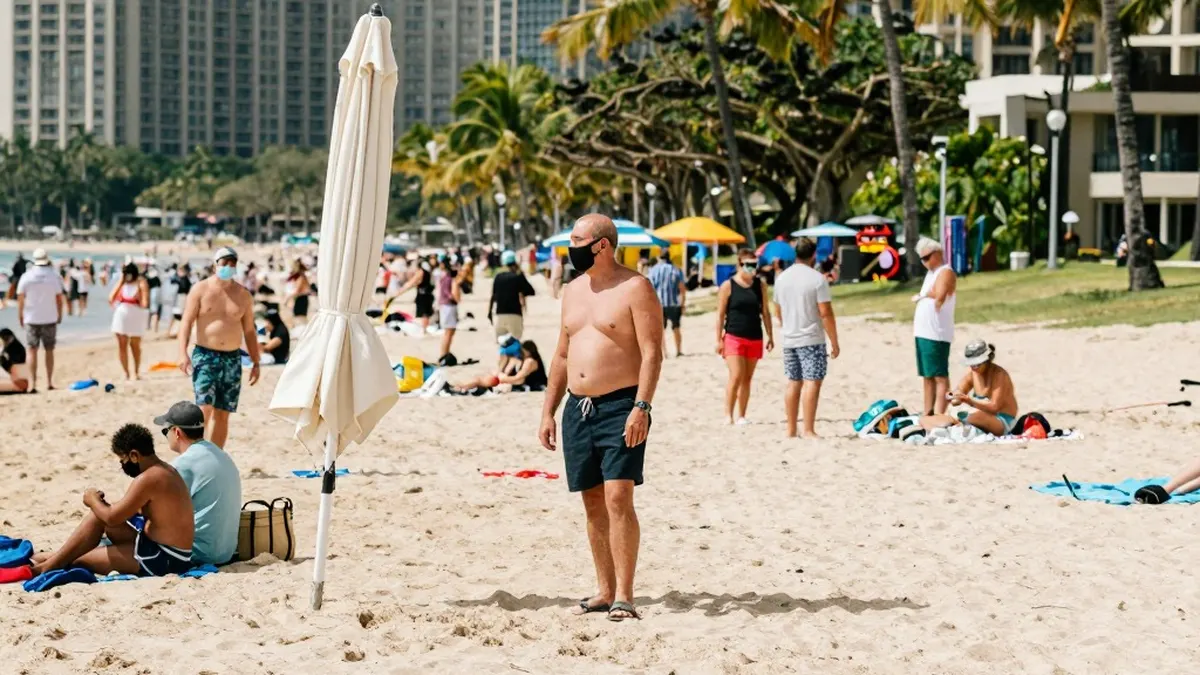
Hawaii, once among the states with the lowest rates of infection, hospitalization and death, has seen cases climb for eight straight weeks and now has the second-highest infection rate in the country, behind only Rhode Island. The state health department believes the true count is five or six times higher than reported, since home test results are not included. The University of Hawaii will require masks indoors again across its 10 campuses beginning Wednesday. Hawaii was the last state to end its general mask mandate and remains the only one requiring all public school students to wear masks indoors, a rule expected to last through the summer and possibly into the next school year.
Tourists have continued to arrive in large numbers. Yaling Fisher, owner of Hawaii Aloha Travel, said bookings have increased during the surge and that she has seen no cancellations. Samantha Hanberg, visiting with her new husband, said the couple left their masks at home in California. Having had COVID-19 early in the pandemic and later becoming fully vaccinated, she said she feels safe. "I want to go back to living and enjoying life, and not being so worried," she said.
California, which formally moved to an "endemic" approach in February, has also seen weekly infection rates rise sharply. School districts in Pacific Grove and Berkeley have restored indoor mask rules, and an outbreak at a Northern California long-term care facility had sickened at least 12 people by Friday. Philadelphia and Providence, Rhode Island, are among the Northeastern districts that have revived mask requirements.
New York City appears unlikely to do the same. Despite another rise in cases, Mayor Eric Adams has all but ruled out a citywide mask mandate unless hospitals are again overwhelmed. The city's school system has stopped closing classrooms when several students test positive, now only recommends masks, and has dropped its vaccination requirement for prom attendance.
Source: Boston.com