Trump's 'Pretend' Strategy Meets Low Approval in Midterm Push
Despite a 35 percent approval rating and a strategy urging supporters to 'pretend' he is on the ballot, President Trump's presence is reshaping the midterm landscape.
By Kofi Costa ·
President Donald Trump is treating the 2026 midterm elections as a direct referendum on his second term, a stance that has intensified the political battle for control of Congress. The Associated Press describes the election as a referendum on the president's performance, with voters weighing high prices and an unpopular war with Iran. This framing has placed the president at the center of campaigns across the country, even though he is not on the ballot in any of the 435 House districts or 35 Senate races.
Trump has held dozens of rallies in the weeks leading up to Election Day, with his schedule including stops in Mississippi, South Carolina, and Texas. He concluded his recent circuit in Salina, Kansas, where he explicitly asked supporters to "pretend I'm on the ballot." This instruction highlights the administration's strategy to link every down-ballot race to the president's popularity, a tactic that has divided some Republican candidates who are trying to keep their distance from his more polarizing statements.
The political calculus is driven by the numbers. 35 percent of U.S. Adults approve of Trump's job performance, while only 25 percent approve of his handling of the economy. About seven in ten Americans say the country is heading in the wrong direction. Most of these voters blame the president for high prices, a sentiment that is fueling the Democratic argument that a change in Congress is necessary to address the cost of living.
Republicans are bracing for the possibility of losing the House, where they can afford to lose no more than two seats to maintain their majority. Democrats need a net gain of three districts to take control of the chamber. The Associated Press notes that one or two seats could tip either chamber, making the battlegrounds critical. In the Senate, Republicans hold 53 seats and can lose only two to maintain control, while Democrats need a net gain of four seats.
The president's involvement has also been marked by ongoing claims about voting fraud. Trump has continued to assert that noncitizens vote in large numbers, a claim that has led his administration to file lawsuits in states like Alaska and California. These legal moves have raised concerns among Democrats about potential interference and the intimidation of local election officials by the Justice Department. Critics argue that these actions risk disenfranchising eligible voters and infringe on states' authority over their own elections.
Financially, the 2026 elections are shaping up to be the most expensive in history. Republican committees have outraised and outspent their Democratic counterparts, aided by Trump-affiliated groups and Elon Musk. However, at the individual candidate level, Democrats have outraised their opponents. An AP analysis of AdImpact data shows that 88.1 percent of Republican general election TV ad spending went to states and districts that Trump won in 2024, with more than $850 million spent in areas where he won by 10 points or more.
The mood in Republican circles is focused on turnout. RNC Chairman Joe Gruters stated that everything depends on voter participation, saying that if they turn out their voters, they will win. In contrast, DCCC Chair Rep. Suzan DelBene described the American people as angry and seeking change. This divergence in strategy is evident in the races, where Democrats are cautiously optimistic about their chances to break the midterm pattern of losing seats.
Voters are making their choices based on personal economic experiences. Mark Barker of Palm Beach Gardens, Florida, said he has been following Trump and thinks he is doing an awesome job. Conversely, James Moore, a 57-year-old librarian in Raleigh, North Carolina, noted that he is paying more taxes and more for healthcare. These individual narratives reflect the broader national debate over the direction of the country under the current administration.
The stakes extend beyond simple party control. If Democrats win even one chamber, investigations and possible impeachment proceedings become likely. House Democratic Leader Hakeem Jeffries, who would be the first Black speaker if his party takes the House, has outlined a 100-day agenda focused on the cost of living and oversight. A strong Democratic night would also boost potential 2028 candidates such as Gavin Newsom, JB Pritzker, and Pete Buttigieg, while potentially complicating the path for Vice President JD Vance.
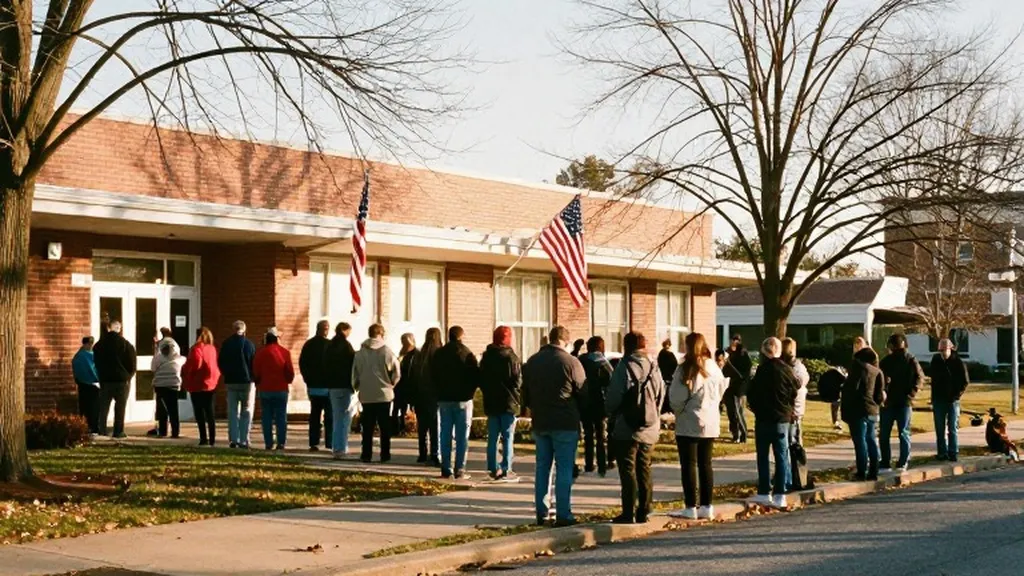
More than 57 million people had already voted as of Monday, surpassing the early vote totals from four years ago in many closely watched states. The U.S. Postal Service added hours and staff to ensure mail ballots are counted on time. With polls open in all 50 states, the outcome will depend on whether the president's rally energy can overcome the economic dissatisfaction reflected in the approval numbers.
Wall Street is also watching the results, as Reuters notes that the outcome could impact investor concerns about AI spending and debt ceiling negotiations. The election will determine the balance of power for the final two years of Trump's term, setting the stage for the 2028 presidential race. As voters head to the polls, the tension between the president's high profile and his low approval ratings remains the defining feature of this election day.